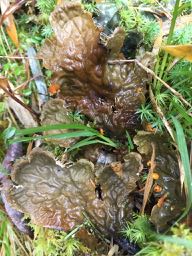
 Further results from ongoing studies on the diversity of the lichen forming fungal genus Peltigera is being published. Vouchers will be deposited in CONN. Magain N., C. Truong, T. Goward, D. Niu, B. Goffinet, E. Sérusiaux, O. Vitikainen, F. Lutzoni & J. Miadlikowska. 2018. Global species delimitation of Peltigera section Peltigera (lichenized Ascomycota, Lecanoromycetes) reveals high species richness with complex biogeographical history and symbiotic patterns of associations. Taxon 67: 836–870. pdf
Abstract reads: This comprehensive phylogenetic revision of sections Peltigera and Retifoveatae of the cyanolichen genus Peltigera is based on DNA sequences from more than 500 specimens from five continents. We amplified five loci (nrITS, β-tubulin and three intergenic spacers part of colinear orthologous regions [COR]) for the mycobiont, and the rbcLX locus for the cyanobacterial partner Nostoc. Phylogenetic inferences (RAxML, BEAST) and species delimitation methods (bGMYC, bPTP, bPP) suggest the presence of 88 species in section Peltigera, including 50 species new to science, hence uncovering a surprisingly high proportion of previously unnoticed biodiversity. The hypervariable region in ITS1 (ITS1-HR) is a powerful marker to identify species within sections Peltigera and Retifoveatae. Most newly delimited species are restricted to a single biogeographic region, however, up to ten species have a nearly cosmopolitan distribution. The specificity of mycobionts in their association with Nostoc cyanobionts ranges from strict specialists (associate with only one Nostoc phylogroup) to broad generalists (up to eight Nostoc phylogroups uncovered), with widespread species recruiting a broader selection of Nostoc phylogroups than species with limited distributions. In contrast, species from the P. didactyla clade characterized by small thalli and asexual vegetative propagules (soredia) associate with fewer Nostoc phylogroups (i.e., are more specialized) despite their broad distributions, and show significantly higher rates of nucleotide substitutions.
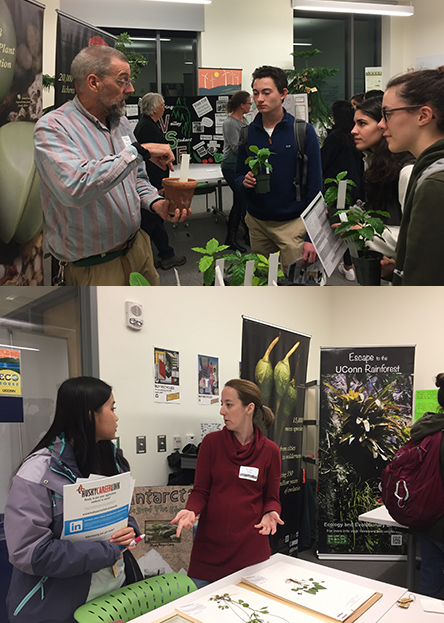 Sarah Taylor and Clint Morse attended the 4th